

The Flite Test Beginner Series is brought to you by Horizon Hobby.
Episode 2: Basic Aerodynamics
We know you’re excited to get in the air. But we also know you’ll have more fun if we can help keep you up there. In this video and article we will go over some basic aerodynamics. We’ll focus on the information that’ll help you grasp the art of flying quickly.
The Basic Plane Parts
-
Fuselage - The main body. Everything connects to this.
-
The Vertical Stabilizer - Keeps the plane’s yaw movement stable.
-
The Horizontal Stabilizer - Keeps the plane’s pitch movement stable.
-
The Wing - Generates lift.

Airfoils
The shape of a wing or propeller blade as seen in cross-section.

-
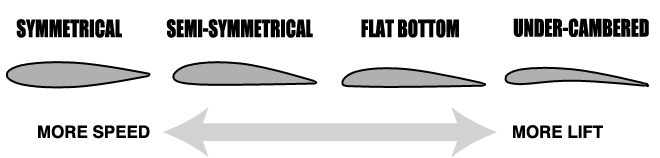
The difference between the top and bottom of the airfoil determines the amount of lift the wing will have. Symmetrical, Semi-Symmetrical and under-cambered are popular airfoils due to their unique characteristics.
-
Symmetrical - Very low drag which means it’s fast and more agile. It’s good for aerobatics. However, it’s not a high lift design.
-
Semi-Symmetrical - Has a high camber, producing a good lift-to-drag ratio.
-
Flat Bottom - Not very common.
-
Under-Cambered - Produces the most lift but it’s not the best choice for performance.
Lift
There are two principle on how a wing generates lift:
1. Bernoulli's Principle
As the velocity of a fluid (air) increases, its pressure decreases. The air on the top of the wing has further to travel in the same amount of time, therefor moving faster and lowering it’s pressure. This allows the high pressure under the wing to push it upwards.

2. Newton’s Law of Motion
Each action has an equal and opposite reaction. Air on the bottom of the wing is deflected down which pushes the wing up. Angle of attack important. This is why a flat plate foamie can fly.

Airflow and Stalls
The common denominator between these Bernoulli and Newton is… Airflow! Too little airflow means you will “stall!” You have to have air moving over your wing or you can’t generate lift.
Stalls are the biggest enemy of any new pilot. They result in loss of control. Most beginner planes recover from stalls more quickly than advanced planes such as jets or warbird.
There are two types of stalls to watch out for.
-
Low Speed Stall - This occurs when your aircraft drops below it’s “stall speed.”
-
Tip Stall - This occurs when you try to turn too tightly. The wing on the inside of the turn moves through the air slower than the outer wing. The inner wing loses lift and often pulls your aircraft into a death spiral.
How do I keep from stalling?!?!
-
"When in doubt level out." A 20-30 degree incline or bank is a lot! Try to keep your plane fairly level. It’s not like a car… you can’t turn sharp or stop.
-
More airspeed means more control. But be careful. Your reaction time needs to mature.
-
Fly your plane high and learn the stall speed. When you get used to what it feels like to stall, it'll help you land without stalling. HERE is a good episode to learn about landing.
Control Surfaces
There are are 3 major sets of control surfaces. The control surfaces deflect the flow of air, in turn, pushes the control surface the opposite direction. This changes the angle of the plane on that axis.
-
Elevator - Controls the pitch angle of the airplane. The elevator is situated horizontally on the tail of the airplane.
-
Rudder - Controls the yaw (Left and Right). The rudder is situated vertically on the tail of the airplane.
-
Ailerons - Controls the roll, or bank of the airplane. The ailerons are located on trailing edge of the wing.
-
Elevons - Controls the pitch AND roll of an airplane. The elevons are a combination of the elevator and ailerons situated on the trailing edge

Transmitter
Transmitters are normally classified as MODE 1 or MODE 2. Most people, including the entire Flite Test crew, use MODE 2 transmitters.

The “High Five” episode will help you remember the proper movement of your control surfaces.
Click HERE to learn how to choose the right R/C plane for you.
If you know someone that may benefit from this article, share it with them. Help us make this hobby friendly and approachable!
Choosing a Plane
0 comments