

The Flite Test Beginner Series is brought to you by Horizon Hobby.
Understanding your R/C control system is very important. The better you understand your components, the better you’ll be able to troubleshoot problems down the road.
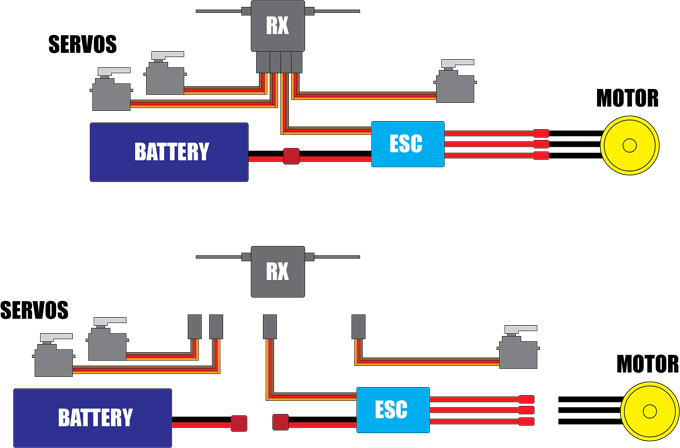
Communication link:
-
You talk to the transmitter (TX)
-
Transmitter talks to the receiver (RX)
-
Receiver talks to the servos and ESC’s
-
Servos moves your control surfaces
-
The ESC drives the motor
Radio Control Transmitter (TX)
-
The transmitter uses radio signals to remotely control the aircraft.
-
The control sticks (gimbals) or switches on the transmitter are each assigned to a channel.
-
The number of channels are how many functions or features can be used to control things on the aircraft.
-
Different brand transmitters have different encryption and channel assignments. Usually they are not cross compatible.
Radio Control Receiver (RX)
-
Receives the encoded radio signal from the TX and converts it to instructions for each component connected to the receiver.
-
Each channel can control a separate function such as a servo, speed controller, lights, landing gear, etc.

Servos
-
Servos comes in many different sizes and shapes, but they have a common purpose: to move control surfaces.
-
Servos are usually classified by weight.
-
9 gram servos are used in most park flyers and are the most common.
-
Servos connect directly to the receiver (RX).

Electronic Speed Control (ESC)
-
The ESC controls the speed of the motor as commanded by the receiver (RX).
-
The main battery plugs into the ESC.
-
Most ESCs have a built in BEC (Battery Elimination Circuit) that provides power to the receiver (RX) and servos.

If you know someone that may benefit from this article, share it with them. Help us make this hobby friendly and approachable!
We would like to thank Horizon Hobby for sponsoring this Beginner Series! Let us know what you think of this content and let Horizon Hobby know as well! You can find out more about Horizon Hobby HERE.
HorizonHobby-BeginnerSeries
R/C Control System
0 comments